
The short version
Seven fast-rising short treks you can start from Pokhara in 2026 — Khumai, Kapuche, Kori, Muldai, Mardi, Panchase and Dhampus — with days, altitude and permits.
- Pokhara is the launchpad. Every trek here starts within a couple of hours' drive of the lakeside — no internal flight, no long approach. Most are 3 to 6 days door to door.
- These are the rising stars, not the warhorses. Khumai Danda, Kapuche Lake, Kori Danda and Muldai are the trails surging on social media right now — quiet ridges with the same Fishtail and Annapurna views as the famous routes.
- Low to moderate altitude. Nothing here forces you above 3,800m, so altitude risk is modest — but Mardi's High Camp and Kori still deserve respect.
- One permit set covers them all. Every trek below sits inside the Annapurna Conservation Area: ACAP NPR 3,000 plus a TIMS card (around NPR 2,000). No restricted-area permit needed.
For twenty-five years we have watched trekkers pour off the same two trails out of Pokhara — Poon Hill and Annapurna Base Camp. They are wonderful, and they are also busy. What has changed since 2024 is the rise of a cluster of shorter, quieter ridge treks that deliver the same Machhapuchhre (Fishtail) and Annapurna panoramas with a fraction of the foot traffic. We call them the new and rising treks near Pokhara, and in 2026 they are the trails our most adventurous guests are asking for by name. This is our honest field guide to seven of them — what each one is, how long it takes, how high it climbs, and who it suits best.


All seven lie inside the Annapurna Conservation Area, so the paperwork is identical for every route: an ACAP entry permit (NPR 3,000 for foreign nationals) and a TIMS card (roughly NPR 2,000). There is no restricted-area permit and no Liaison officer required — these are open, teahouse-supported trails. If you want the full picture of Nepal's permit system, our 2026 trekking permits guide and the permits hub lay it all out, and the Annapurna region guide covers the wider area in depth.
Khumai Danda — the quiet alternative to Mardi Himal
Khumai Danda is the one we recommend most often to trekkers who looked at Mardi Himal and wished it were less crowded. It is a forested ridge on the north side of Pokhara topping out around 3,245m, with a higher vantage at Korchan (about 3,700m) for those who want one more climb. The reward is a head-on view of Machhapuchhre that rivals anything on the Mardi trail, reached through rhododendron woods and small Gurung settlements such as Saripakha and Hile Kharka.
- Days: 4 to 5 from Pokhara (a fast 3-day version exists)
- Difficulty: Moderate — steady uphill on good trail
- Max altitude: ~3,245m (Korchan ~3,700m)
- Best for: Trekkers who want Mardi's views without Mardi's queues
- Permit: ACAP + TIMS
Because the ridge can later connect to Mardi Himal or even Annapurna Base Camp, Khumai is also a flexible building block for a longer trip. See it on our Khumai Danda Trek (5 days).
Kapuche Lake & Sikles — the world's lowest glacial lake
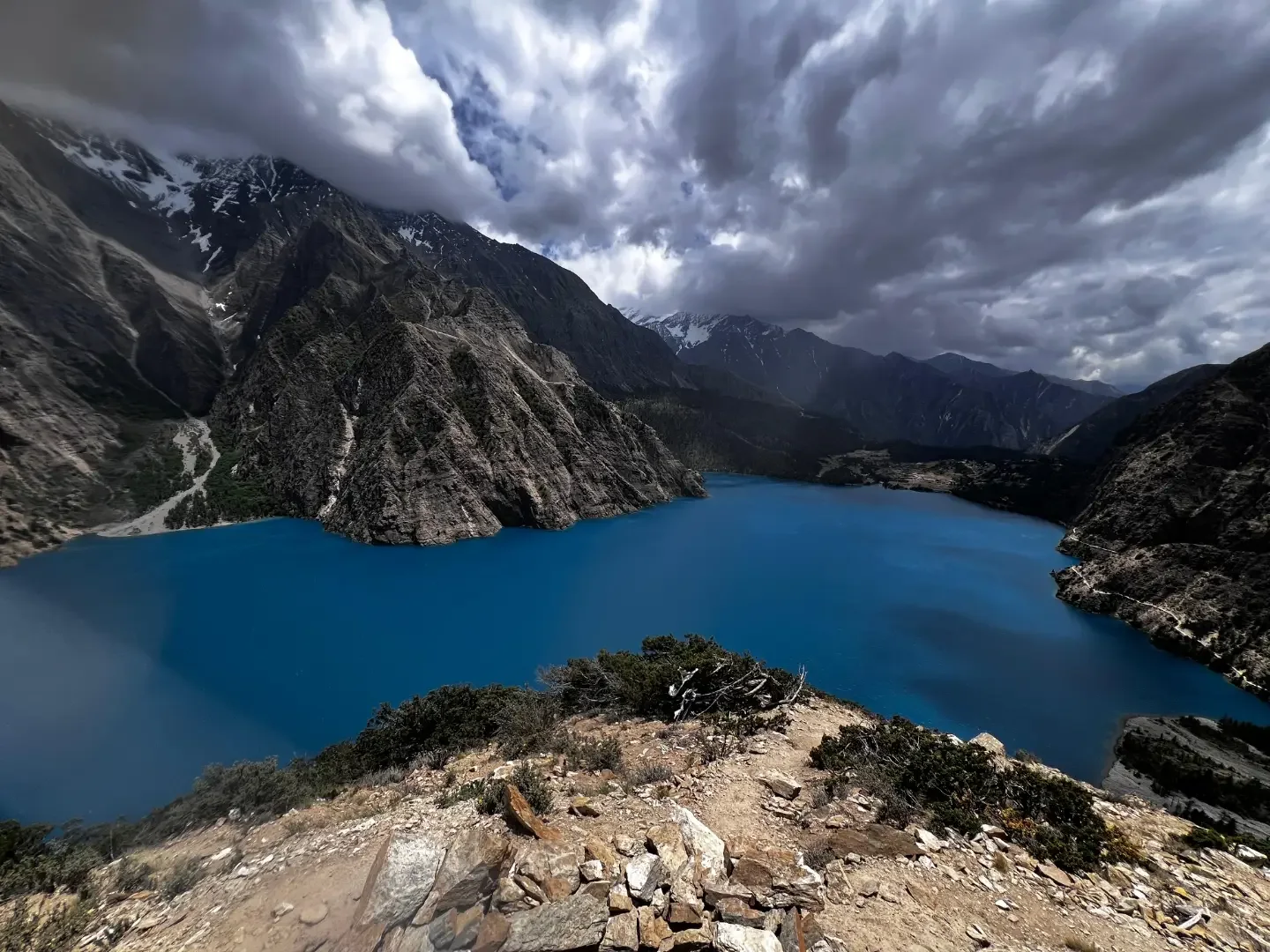
This is the headline-grabber of the group. Kapuche Lake sits at roughly 2,546m, which makes it — by most accounts — the lowest-altitude glacial lake on Earth, when nearly every other glacier lake in Nepal lies above 4,000m. The turquoise water beneath sheer rock walls, fed by avalanches off Annapurna II and IV, is genuinely unlike anything else near Pokhara. The route runs through Sikles, one of the largest and most traditional Gurung villages in the country.
- Days: 4 to 5 from Pokhara
- Difficulty: Easy to moderate — low altitude, a few steep stone-stair sections
- Max altitude: ~2,546m at the lake
- Best for: Travellers who want dramatic mountain scenery with minimal altitude risk, plus deep cultural immersion in Sikles
- Permit: ACAP + TIMS
It is one of the most photogenic short treks in the whole Annapurna region. Walk it with us on the Kapuche Lake & Sikles Trek (5 days).
Kori Danda — the panorama above Sikles
If Kapuche is the low road from Sikles, Kori is the high one. The viewpoint at around 3,800m opens a sweeping panorama of Annapurna II, Lamjung Himal, Himlung and Machhapuchhre, and it remains one of the least-trodden ridges in the region despite the views on offer. The two routes pair beautifully — many of our guests combine Kori and Kapuche into a single loop out of Sikles.
- Days: 4 to 5 from Pokhara (longer combined with Kapuche)
- Difficulty: Moderate — the highest point in this roundup at ~3,800m
- Max altitude: ~3,800m at Kori Danda
- Best for: Trekkers who want a genuine high ridge and big-mountain panorama away from the crowds
- Permit: ACAP + TIMS
Details and dates on the Kori Danda Trek (5 days).
Muldai View Point — the quieter Poon Hill
Poon Hill has drawn sunrise crowds for decades. Muldai, at 3,637m, delivers an arguably better 360-degree panorama — Dhaulagiri, Annapurna South, Annapurna I and more than twenty named peaks — with a fraction of the people. It threads the classic Ghorepani region but stays on the quieter ridge, often combined with Poon Hill itself for those who want both.
- Days: 5 to 6 from Pokhara (our package runs 6)
- Difficulty: Moderate — rhododendron forest and stone staircases
- Max altitude: ~3,637m at Muldai
- Best for: Anyone who loved the idea of Poon Hill but wants solitude at sunrise
- Permit: ACAP + TIMS
It is the thinking trekker's Poon Hill. Book the Muldai View Point Trek (6 days).
Mardi Himal — the modern classic
Mardi Himal is the trek that started this whole wave. A decade ago it was a hidden ridge; today it is a modern classic, and deservedly so. You sleep as high as High Camp (around 3,580m) and push to the Upper Viewpoint or Base Camp (about 4,500m) for an astonishingly close look at the Fishtail's east face. It is the highest-feeling trek in this list and the one we suggest if you want a taste of real high-altitude trekking on a short timetable.
- Days: 4 to 5 from Pokhara
- Difficulty: Moderate — short but with a meaningful altitude gain
- Max altitude: ~4,500m at Base Camp (sleeping ~3,580m at High Camp)
- Best for: Fit first-timers wanting a high viewpoint without a two-week commitment
- Permit: ACAP + TIMS
Because Mardi now sees real traffic in peak season, it sits at the threshold between "rising" and "established" — but it remains the benchmark every newer ridge is measured against. See the Mardi Himal Trek (4 days).
Panchase — the easy forest ridge
Panchase is our pick for trekkers who want a gentle, green introduction to the Annapurna foothills. The high point sits around 2,500m, the gradients are forgiving, and the trail winds through some of the most biodiverse oak and rhododendron forest near Pokhara, with sweeping views of the Annapurna and Dhaulagiri ranges from the ridge. There is almost no altitude concern here, which makes it ideal off-season and for families.
- Days: 3 to 4 from Pokhara
- Difficulty: Easy — gentle, well-graded forest trail
- Max altitude: ~2,500m at Panchase peak
- Best for: Families, first-time trekkers, and anyone trekking in the shoulder months
- Permit: ACAP + TIMS
A peaceful forest walk close to the city — the Panchase Trek (4 days).
Dhampus & Australian Camp — the easiest short sunrise trek
If you have only a couple of days and want one perfect Himalayan sunrise, this is it. Australian Camp sits at about 2,055m, the walking is short and almost entirely gentle, and the dawn light over Annapurna South and Machhapuchhre from the meadow is one of the loveliest in the country. We send families with young children and older travellers on this route without hesitation.
- Days: 2 to 3 from Pokhara
- Difficulty: Easy — the gentlest trek in this roundup
- Max altitude: ~2,065m at Australian Camp
- Best for: Short itineraries, families, and a no-stress first taste of trekking
- Permit: ACAP + TIMS
The perfect overnight escape — the Dhampus & Australian Camp Trek (3 days).
How to choose between them
Start with how long you have and how high you want to go. For an easy first taste, choose Dhampus & Australian Camp or Panchase. For the famous viewpoints without the crowds, choose Muldai or Khumai Danda. For something genuinely different, choose Kapuche Lake. For the highest ridge and the biggest panorama, choose Kori Danda or Mardi Himal. If you are weighing these against the better-known routes, our best treks in Nepal overview and the side-by-side trek comparison are the fastest way to decide, and our roundup of short treks from Pokhara goes deeper on the logistics.
Best time to go
The two prime windows are autumn (late September to November) for the clearest skies and stable weather, and spring (March to May) for the rhododendron bloom that sets these forested ridges alight. Winter is perfectly doable on the lower routes — Kapuche, Panchase and Dhampus — though Kori, Mardi and Muldai can get cold and occasionally snowy up top. We avoid the June-to-August monsoon for views, though the hills are at their greenest then. For the full seasonal breakdown see the best time to trek Nepal in 2026.
Altitude, safety and going with a guide
None of these treks is extreme, but Mardi's Base Camp at ~4,500m and Kori at ~3,800m are high enough that a small number of people will feel the altitude. Ascend at a steady pace, hydrate well, and never ignore a persistent headache — our primer on altitude sickness prevention and treatment is worth reading before you go. Several of these trails are new enough that signage and teahouse spacing are still evolving, which is exactly why a local guide pays for itself; our note on whether you need a guide in 2026 explains the current rules. As a Pokhara-based operator since 1998, we run every one of these routes with NMA-licensed guides who grew up in these valleys.
Which of these treks is the easiest?
Dhampus & Australian Camp is the easiest — short, gentle and only around 2,055m at its highest. Panchase is a close second. Both are ideal for families and first-time trekkers.
Do I need a permit for these treks?
Yes. Every trek in this list sits inside the Annapurna Conservation Area, so you need an ACAP entry permit (NPR 3,000 for foreign nationals) plus a TIMS card (around NPR 2,000). No restricted-area permit is required. We arrange all permits for you.
Is Khumai Danda really a good alternative to Mardi Himal?
For many people, yes. Khumai tops out around 3,245m with comparable Machhapuchhre views but far fewer trekkers. If you want the higher 4,500m feel of Mardi's Base Camp, Mardi still wins; if you want quiet and a similar panorama, Khumai is excellent.
What makes Kapuche Lake special?
At roughly 2,546m it is widely described as the world's lowest-altitude glacial lake, when nearly every other glacier lake in Nepal sits above 4,000m. The turquoise water beneath sheer avalanche-fed walls, combined with the Gurung village of Sikles, makes it one of the most distinctive short treks near Pokhara.
Can I combine Kori Danda and Kapuche Lake?
Absolutely — they share the same trailhead village of Sikles and are frequently walked together as one loop, giving you both the ~3,800m Kori ridge panorama and the low glacial lake in a single trip. Ask us and we will build the combined itinerary.
When is the best time to trek near Pokhara?
Autumn (late September to November) for the clearest mountain views, and spring (March to May) for the rhododendron bloom. The lower routes such as Kapuche, Panchase and Dhampus are also good in winter.
Private Annapurna departures on any date, hand-picked NMA guides, and 25+ years on these trails. Tell us your dates — we usually reply within a few hours.
Browse Annapurna treks & tours → Read the Annapurna guide →
Written by
Travel Himalaya NepalPokhara-based, NMA-certified trekking guides. We’ve led 5,000+ treks across the Annapurna and Everest regions since 1998 — every word here comes from the trail. More from this author →
Share this article
Ready to Trek?
From reading about it to standing on it
Our Pokhara-based guides have been doing this since 1998. Tell us your dates and fitness level — we'll build your perfect itinerary. Free, no obligation.
Why trek with our licensed agencyMore guides like this
Popular trips to consider
Free Trekker's Insider Guide
Permits, packing lists, cost breakdowns — no fluff.
We send one useful email. You can unsubscribe anytime.