
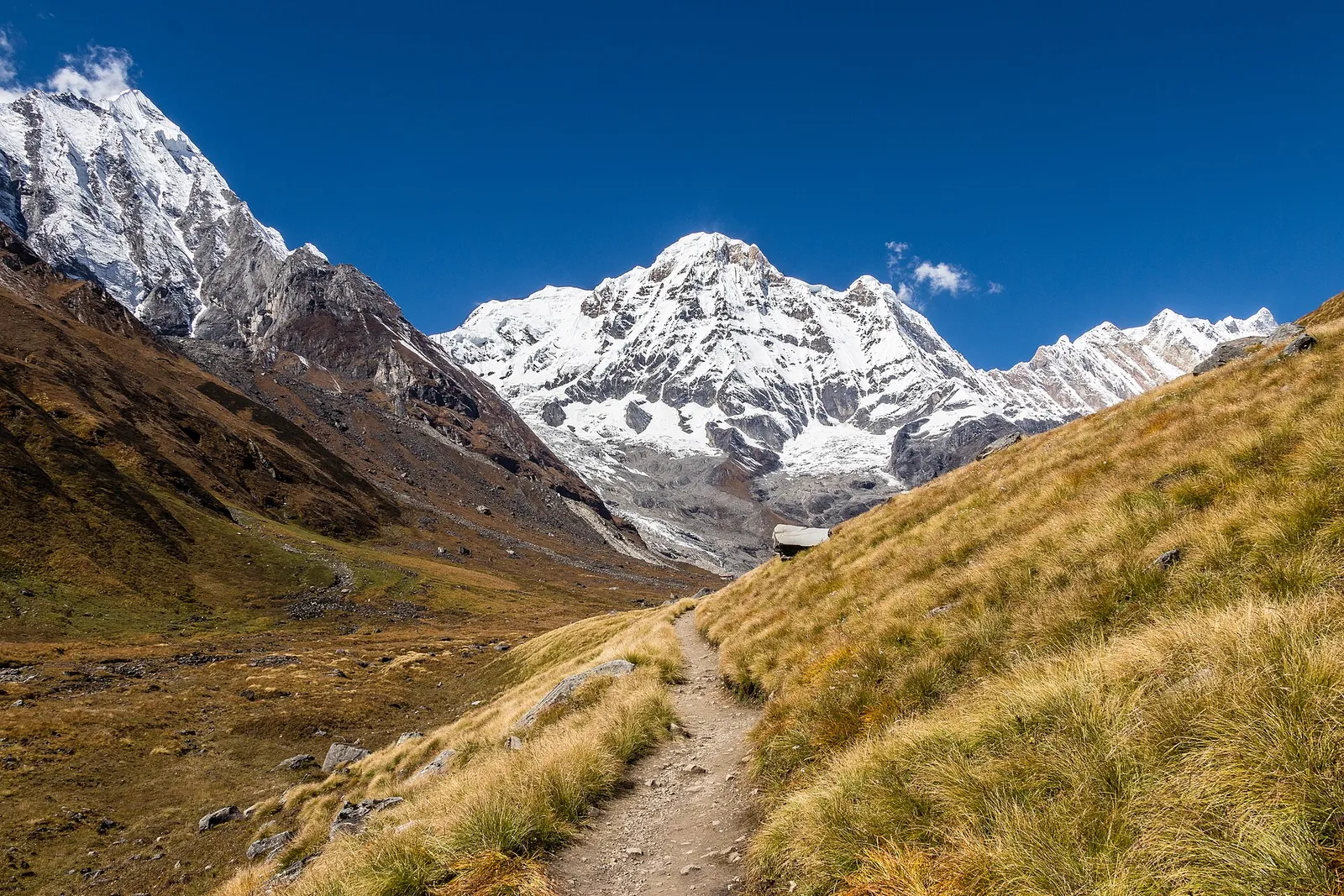
The short version
Embark on a journey through the heart of the Himalayas with our comprehensive guide to the Annapurna Base Camp (ABC) Trek. This guide is meticulously crafted to help you navigate one of Nepal’s most beloved trekking routes, offering essential insights into planning, execution, and what to expect along the way. Table: Key Takeaways for the […]
The Annapurna Base Camp (ABC) trek is the Himalaya distilled into one unforgettable walk: rhododendron forest, terraced Gurung villages and, at the end, a glacial amphitheatre ringed by 7,000- and 8,000-metre giants. After guiding this trail since 1998, we have written this pillar guide to give you everything you need to plan it well — route, difficulty, cost, permits, timing, packing and accommodation — in honest, current detail for 2026.



- Duration: 6 to 14 days; our classic guided itinerary is 6 days from Pokhara.
- Difficulty: Moderate — long descents and stone staircases, but no technical climbing.
- Max altitude: 4,130 m at Annapurna Base Camp.
- Best seasons: Spring (Mar–May) and autumn (Sept–Nov).
- Permits: ACAP (NPR 3,000) + TIMS (NPR 2,000); a licensed guide is mandatory for all foreign trekkers.
- Typical cost: USD 650–1,200 per person on a guided package.
Overview: what makes ABC special
Unlike treks that simply approach the mountains, ABC takes you inside them. The trail funnels through the Modi Khola gorge and opens into the Annapurna Sanctuary — a high glacial basin where you are surrounded on all sides by Annapurna I (8,091 m), Annapurna South, Hiunchuli, Gangapurna and the unmistakable fishtail summit of Machhapuchhare (Machhapuchhre, 6,993 m). In a single week you pass from sub-tropical forest to alpine moraine, sleeping in family-run teahouses among the Gurung and Magar communities who have shaped this valley for centuries.
It is the most rewarding short trek in Nepal: high enough to feel genuinely Himalayan, short enough to fit a two-week holiday, and accessible from Pokhara without an internal flight. For a deeper dive into the region's villages, viewpoints and side-trails, see our full Annapurna region guide.
Route and itinerary
Most ABC treks begin with a short drive from Pokhara to the trailhead at Nayapul or Siwai/Jhinu, then follow the Modi Khola upstream through Chhomrong, Bamboo, Dovan and Deurali before the final climb past Machhapuchhare Base Camp (MBC) to ABC itself. A relaxed 14-day version weaves in the classic Ghorepani–Poon Hill sunrise loop; our streamlined 6-day ABC itinerary goes straight for the Sanctuary.
Drive from Pokhara, then trek through Gurung villages to Chhomrong (2,170 m), the gateway to the Sanctuary, with your first close view of Machhapuchhare.
Forested staircases via Bamboo and Dovan to Deurali and MBC, then the dawn push to Annapurna Base Camp (4,130 m) for sunrise on Annapurna I.
Retrace through Bamboo to the natural hot springs at Jhinu Danda, then back to Pokhara — tired legs, full memory card.
Spend the first night at Chhomrong rather than pushing higher. It splits the big descent-and-climb sections evenly and gives your body a gentle altitude head-start before the Sanctuary.
Difficulty: how hard is ABC?
ABC is graded moderate. There is no technical climbing, scrambling or glacier travel — but do not underestimate it. The trail's signature challenge is relentless stone staircases (the Chhomrong descent alone drops and re-climbs over 2,000 steps), and you reach 4,130 m, high enough for altitude to matter. If you can comfortably walk 5–7 hours a day on hilly terrain, you can do ABC. Build up with hill walks and stair training in the two months before you fly.
Because the ascent profile is steady rather than extreme, serious altitude sickness is less common here than on Everest Base Camp — but it does occur. Read our dedicated guide on altitude sickness prevention and treatment before you go, and never ignore a persistent headache at MBC or ABC.
Avalanche-prone sections between Deurali and MBC can close after heavy snow, especially in winter and early spring. Always trek with a licensed guide who knows the current trail conditions and will reroute or wait if needed.
Cost: what you'll actually spend in 2026
A guided ABC package from a local Nepali operator typically runs USD 650–1,200 per person, depending on group size, trek length and comfort level. International operators charge considerably more for the same trail. If you organise the logistics yourself, budget around USD 35–50 per day on the trail for food, lodging and extras. For a full line-by-line breakdown, see our ABC trek cost guide for 2026.
| Item | Typical 2026 cost |
|---|---|
| ACAP permit (foreigner) | NPR 3,000 (~USD 25) |
| TIMS card (foreigner) | NPR 2,000 (~USD 17) |
| Licensed guide (mandatory) | USD 25–35 / day |
| Porter (optional) | USD 20–25 / day |
| Teahouse room | USD 5–15 / night |
| Meals on the trail | USD 7–10 / meal |
| Guided package (all-in) | USD 650–1,200 |
Permits: ACAP, TIMS and the guide rule
Two permits are required to enter the Annapurna Conservation Area: the ACAP (Annapurna Conservation Area Permit, NPR 3,000 for foreigners / NPR 1,000 for SAARC nationals) and the TIMS card (NPR 2,000 / NPR 1,000 for SAARC). Children under 10 are exempt from ACAP. Both are issued by the Nepal Tourism Board offices in Kathmandu and Pokhara, and they are checked at points along the trail — keep them accessible.
Since 1 April 2023, the Government of Nepal requires all foreign trekkers to hire a licensed guide for routes that need a TIMS card, including ABC — solo independent trekking is no longer permitted. When you book a guided trip with us, we arrange every permit on your behalf. For the full permit walkthrough see our Annapurna permits guide and the official ACAP + TIMS reference.
Permit fees are set by Nepal's authorities and can change between seasons. We confirm the current ACAP and TIMS rates with the issuing office before every departure, so the figure on your invoice is always up to date.
Best time to trek
The two prime windows are spring (March–May) — when the rhododendron forests below Chhomrong erupt in red and pink — and autumn (September–November), which delivers the clearest, most stable skies of the year. Winter (Dec–Feb) is quiet and beautiful but cold, with snow and avalanche risk near the Sanctuary; the monsoon (Jun–Aug) brings rain, leeches and clouded views. For a month-by-month comparison across all of Nepal, see our best time to trek Nepal 2026 guide.
What to pack
Pack in layers and pack light. The trail spans sub-tropical heat at the trailhead and sub-zero dawns at ABC, so a layering system beats a single heavy coat. Essentials: broken-in trekking boots, a warm down jacket, thermal base layers, a waterproof shell, a 4-season sleeping bag liner or bag, sun protection, a headtorch, a reusable water bottle with purification, and a basic first-aid kit. Our complete ABC packing list covers every item by category.
Carry refillable bottles and purification tablets or a filter instead of buying bottled water. It is cheaper, lighter on your wallet, and keeps plastic out of the Sanctuary — see our responsible trekking commitments.
Accommodation along the way
You sleep in teahouses — family-run lodges offering a simple bed, a warm dining room and home-cooked meals (the dal bhat is endless). Lower-altitude lodges in Chhomrong and Jhinu are increasingly comfortable, some with attached bathrooms and hot showers; higher up at Deurali, MBC and ABC, rooms become more basic and warmth comes from the communal stove. In peak season the upper teahouses fill quickly, which is another reason a guided trip — with rooms held in advance — pays off.
Extending your trek
If you have extra days, the Ghorepani–Poon Hill sunrise loop folds neatly onto the front of an ABC trek, and the gentler Mardi Himal trek shares the same Pokhara gateway. Trekkers wanting a bigger challenge often look next to the Annapurna Circuit or, further afield, the Everest Base Camp trek. Browse all options on our tours page.
How difficult is the Annapurna Base Camp trek?
It is graded moderate. There is no technical climbing, but you will face long days of stone staircases and reach 4,130 m. Anyone who can comfortably walk 5–7 hours a day on hilly terrain, with two months of hill and stair training beforehand, can complete it.
How many days do I need for ABC?
Between 6 and 14 days. Our streamlined guided itinerary covers it in 6 days from Pokhara; longer versions add the Ghorepani–Poon Hill loop and extra acclimatisation. Allow buffer days for weather, especially in winter and early spring.
What permits do I need for the ABC trek in 2026?
An ACAP permit (NPR 3,000 for foreigners) and a TIMS card (NPR 2,000), both issued in Kathmandu or Pokhara and checked along the trail. Since April 2023 a licensed guide is also mandatory for all foreign trekkers. We arrange every permit for you.
How much does the ABC trek cost?
A guided package from a local operator typically costs USD 650–1,200 per person, depending on group size and trek length. Independent trekkers on the trail spend roughly USD 35–50 per day. See our 2026 cost breakdown for the full detail.
When is the best time to do the ABC trek?
Spring (March–May) for rhododendron blooms and autumn (September–November) for the clearest skies. Winter is cold with avalanche risk near the Sanctuary, and the monsoon brings rain and obscured views.
Can I trek to Annapurna Base Camp without a guide?
No. Since 1 April 2023 the Government of Nepal requires all foreign trekkers to hire a licensed guide on routes needing a TIMS card, which includes ABC. Solo independent trekking is no longer permitted on this trail.
NMA-certified guides, every permit handled, teahouses booked ahead and a flawless safety record since 1998. Let us take care of the logistics so you can focus on the mountains.
View the 6-Day ABC Trek →Private Annapurna departures on any date, hand-picked NMA guides, and 25+ years on these trails. Tell us your dates — we usually reply within a few hours.
Browse Annapurna treks & tours → Read the Annapurna guide →
Written by
Travel Himalaya NepalPokhara-based, NMA-certified trekking guides. We’ve led 5,000+ treks across the Annapurna and Everest regions since 1998 — every word here comes from the trail. More from this author →
Share this article
Ready to Trek?
From reading about it to standing on it
Our Pokhara-based guides have been doing this since 1998. Tell us your dates and fitness level — we'll build your perfect itinerary. Free, no obligation.
Why trek with our licensed agencyMore guides like this
Popular trips to consider
Free Trekker's Insider Guide
Permits, packing lists, cost breakdowns — no fluff.
We send one useful email. You can unsubscribe anytime.