
The short version
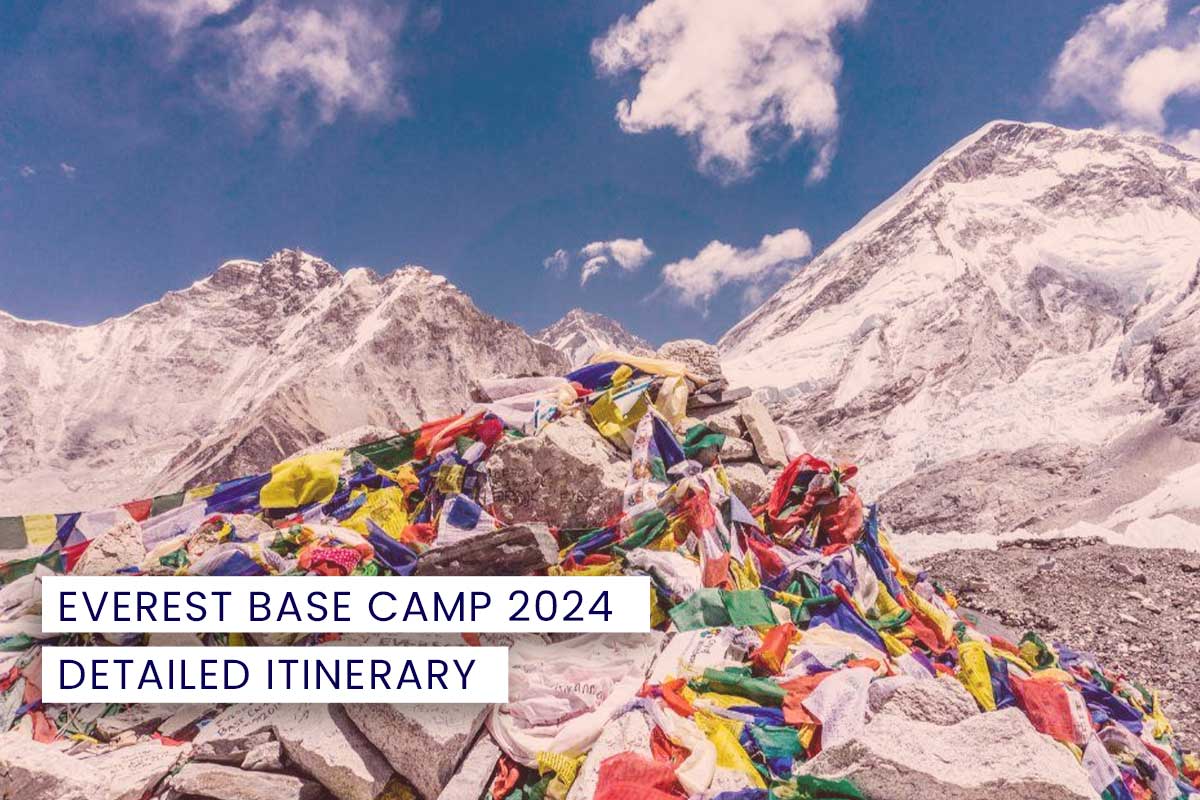
The Everest Base Camp Trek (EBC Trek) is not just a hike; it’s an adventure that takes you into the heart of the Himalayas, culminating at the foot of the legendary Mount Everest, the crown jewel of the world. we’ll explore Everest Base Camp Trek Detailed Itinerary that we have updated for 2024. This trek […]
The Everest Base Camp Trek is not just a hike — it is a 14-day journey into the heart of the Khumbu, culminating at the foot of the world's highest mountain. After guiding this route for more than 25 years, we have refined the day-by-day itinerary below to give your body the acclimatisation it needs while keeping the pace enjoyable. Here is our detailed EBC itinerary, fully updated for 2026.


- Standard itinerary: 14 days door-to-door (12 days trekking + 2 acclimatisation rest days), starting and ending in Kathmandu.
- Highest points: Kala Patthar 5,643 m (18,513 ft) for the sunrise view; Everest Base Camp itself sits at 5,364 m (17,598 ft).
- Permits (2026): Sagarmatha National Park entry (NPR 3,000 / ~US$30) + Khumbu Pasang Lhamu Rural Municipality permit (NPR 3,000 / ~US$23). No TIMS card needed inside Khumbu.
- Guide: A licensed guide is mandatory in Nepal's national parks since 2023 — solo trekking is no longer permitted.
- Best seasons: Spring (March–May) and autumn (late September–November).
This trek is a dream for many, but it is important to set realistic expectations. The EBC Trek is graded moderate to challenging: the trails are non-technical, but the altitude is the real test. Good cardiovascular fitness and disciplined acclimatisation matter far more than raw strength. The reward is immeasurable — breathtaking mountain scenery, authentic Sherpa culture, and a profound sense of achievement as you reach Base Camp. For a fuller cost picture before you commit, see our Everest Base Camp cost guide for 2026 and the official EBC permit walkthrough.
In peak season (March–May and Sept–Nov) the Lukla flight no longer departs from Kathmandu. The Civil Aviation Authority shifts operations to Manthali Airport in Ramechhap, a 4.5–5 hour pre-dawn drive from Kathmandu, followed by a 15–25 minute mountain flight to Lukla. We build this transfer into your itinerary and brief you fully in Kathmandu.
Everest Base Camp Trek Detailed Itinerary
Pre-Trek in Kathmandu (Days 1–2)
Your Everest Base Camp adventure begins in Kathmandu, Nepal's vibrant capital.
- Day 1 — Arrival in Kathmandu (1,400 m): You are met at the airport and transferred to your hotel. Relax, adjust to the time difference, and explore the ancient temples, bazaars and courtyards of the old city at your own pace.
- Day 2 — Permits, briefing and final preparations: Today is dedicated to readying your trek. Your guide arranges the Sagarmatha National Park and Khumbu Pasang Lhamu permits, runs a full safety briefing, and helps you finalise any gear rentals so your pack is dialled in for the days ahead.
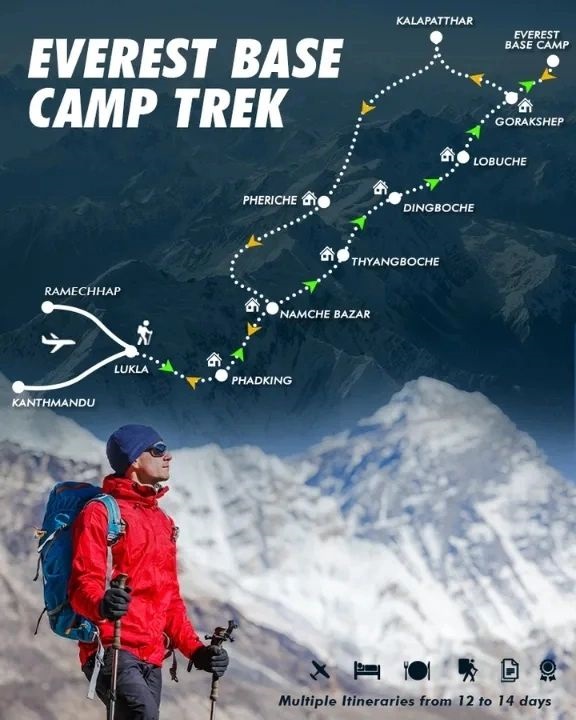
The Trek Begins — Lukla & the Lower Khumbu
- Day 3 — Fly to Lukla (2,840 m), trek to Phakding (2,610 m): An exhilarating, weather-dependent flight delivers you to Lukla, the "gateway to Everest" with its famously short runway. From there a gentle downhill walk to Phakding eases your body into the rhythm of the trail.
- Day 4 — Trek to Namche Bazaar (3,440 m): Crossing high suspension bridges over the Dudh Koshi, you climb steeply to Namche Bazaar, the bustling Sherpa trading hub and capital of the Khumbu. Stunning vistas open up along the way.
- Day 5 — Acclimatisation day in Namche Bazaar: A vital rest day — but not an idle one. We hike up to the Everest View Hotel for your first panorama of Everest, Ama Dablam and Thamserku (weather permitting), then descend to sleep. "Climb high, sleep low" is the golden rule.
Ascending Higher — Tengboche & Dingboche
- Day 6 — Trek to Tengboche (3,860 m): A scenic day ending at the famous Tengboche Monastery, perched on a ridge with sweeping views of Everest and Ama Dablam. If timing allows, witness the monks' afternoon prayer ceremony.
- Day 7 — Trek to Dingboche (4,410 m): The treeline falls away and the landscape turns alpine. Dingboche, surrounded by stone-walled fields and prayer flags, is a key acclimatisation hub.
- Day 8 — Acclimatisation day in Dingboche: A second rest day. We take an acclimatisation hike up Nangkartshang ridge (around 5,000 m) for views of Makalu, Lhotse and Island Peak, then return to Dingboche to sleep low.
The two rest days at Namche and Dingboche are the single biggest reason our trekkers succeed. Itineraries that skip Dingboche's acclimatisation day to save money are the most common cause of altitude sickness on this route. Never trade a rest day for speed.
Pushing Towards Everest Base Camp
- Day 9 — Trek to Lobuche (4,940 m): The trail climbs past Thukla Pass, where memorials honour climbers lost on Everest. You reach Lobuche beside the moraine of the vast Khumbu Glacier, the largest in the Himalaya.
- Day 10 — Trek to Gorak Shep (5,164 m) & Everest Base Camp (5,364 m): A demanding day along the glacier to Gorak Shep, your highest overnight stop. In the afternoon you make the surreal side trip to Everest Base Camp itself, standing at the foot of the world's tallest mountain before returning to Gorak Shep to sleep.
Kala Patthar & the Descent
- Day 11 — Sunrise at Kala Patthar (5,643 m), descend to Pheriche (4,240 m): A pre-dawn climb to Kala Patthar rewards you with the most dramatic sunrise view of Everest on the entire trek. After photos, you descend to the richer air of Pheriche.
- Day 12 — Trek back to Namche Bazaar (3,440 m): A long but satisfying descent retracing the trail through Tengboche, with familiar comforts and thicker air waiting at Namche.
- Day 13 — Trek back to Lukla (2,840 m): The final day on foot brings you to Lukla. Celebrate the completion of your trek with your guide and crew over a well-earned meal.
- Day 14 — Fly Lukla to Kathmandu: A scenic morning flight returns you to Kathmandu (via Manthali in peak season). Rest, reflect, or shop for souvenirs — the journey is complete.
Day-by-Day Summary Table
| Day | Route | Max altitude | Distance | Difficulty |
|---|---|---|---|---|
| 1 | Arrive Kathmandu | 1,400 m | — | — |
| 2 | Permits & briefing | 1,400 m | — | — |
| 3 | Fly Lukla → Phakding | 2,840 m | 8 km | Easy |
| 4 | Phakding → Namche Bazaar | 3,440 m | 11 km | Moderate |
| 5 | Acclimatisation — Namche | 3,880 m | ~6 km | Rest day |
| 6 | Namche → Tengboche | 3,860 m | 10 km | Moderate |
| 7 | Tengboche → Dingboche | 4,410 m | 9 km | Moderate |
| 8 | Acclimatisation — Dingboche | ~5,000 m | ~5 km | Rest day |
| 9 | Dingboche → Lobuche | 4,940 m | 8 km | Moderate |
| 10 | Lobuche → Gorak Shep → EBC | 5,364 m | 13 km | Challenging |
| 11 | Kala Patthar → Pheriche | 5,643 m | 15 km | Challenging |
| 12 | Pheriche → Namche Bazaar | 4,240 m | 20 km | Moderate |
| 13 | Namche → Lukla | 3,440 m | 18 km | Moderate |
| 14 | Fly Lukla → Kathmandu | 1,400 m | — | — |
Permits & Costs for 2026
Two permits are required for the standard EBC route in 2026 — and the long-standing TIMS card is no longer needed inside the Khumbu, having been replaced by the local rural-municipality permit. Both are arranged by your guide; you simply bring your passport and passport photos.
| Permit | Cost (non-SAARC) | Where to get it |
|---|---|---|
| Sagarmatha National Park entry | NPR 3,000 (~US$30) | Kathmandu or Monjo gate |
| Khumbu Pasang Lhamu Rural Municipality | NPR 3,000 (~US$23) | Lukla / Monjo |
| Licensed guide (mandatory) | Included in package | Your operator |
For a typical 14-day guided package from a reputable Nepali operator — including domestic flights, permits, teahouse accommodation, meals on the trail, a licensed guide and a porter — budget roughly US$1,400–US$2,200 per person depending on service level and group size. Permit, season and currency figures should always be confirmed close to departure; the Department of National Parks (DNPWC) publishes the official park fees.
Above 3,000 m, ascend no more than ~500 m of sleeping altitude per day and take a rest day every 1,000 m of gain. Watch for headache, nausea, dizziness and disturbed sleep. If symptoms worsen, the only reliable cure is to descend. Read our full guide to altitude sickness prevention and treatment before you travel.
Tips & Recommendations
Broken-in boots with ankle support, warm waterproof layers, quick-dry trekking clothes, a four-season sleeping bag, sun hat, glacier sunglasses, sunscreen and a reliable headlamp.
Non-negotiable. Choose a policy that explicitly covers trekking to 6,000 m and helicopter medical evacuation — standard travel insurance rarely does.
Train 8–12 weeks ahead with hiking, stair work, running or cycling. Long back-to-back walking days matter more than gym strength.
Look for NMA-certified guides, transparent itineraries with proper rest days, and verifiable trekker reviews. Avoid packages that cut acclimatisation days to lower the price.
Plan Your Onward Reading
Timing your trek well is half the battle — see our guide to the best time to trek Nepal in 2026, and explore the wider region in our Everest region guide. If you are still comparing routes, the full tour collection lays out every Himalayan option side by side.
FAQs about the Everest Base Camp Trek
How difficult is the Everest Base Camp Trek?
It is graded moderate to challenging. The trails are non-technical and require no climbing skills, but the high altitude makes it demanding. Good cardiovascular fitness and disciplined acclimatisation — not raw strength — are what get trekkers to Base Camp safely.
How long is the Everest Base Camp Trek?
Our standard itinerary is 14 days door-to-door from Kathmandu: 12 trekking days plus two dedicated acclimatisation rest days at Namche and Dingboche. Shorter 12-day versions exist but cut acclimatisation and carry a higher altitude-sickness risk.
What is the best time to trek to Everest Base Camp?
Spring (March–May) and autumn (late September–November) offer the clearest skies, stable temperatures and the most reliable Lukla flights. Winter is cold but quiet; the June–August monsoon brings cloud and frequent flight delays.
What permits do I need in 2026?
Two: the Sagarmatha National Park entry permit (NPR 3,000 / ~US$30 for non-SAARC nationals) and the Khumbu Pasang Lhamu Rural Municipality permit (NPR 3,000 / ~US$23). The old TIMS card is no longer required inside the Khumbu. Your guide arranges both.
Do I need a guide for the EBC Trek?
Yes. Since 2023, Nepal requires a licensed guide for treks inside national parks, and solo trekking is no longer permitted. Beyond the rules, a guide manages your acclimatisation, navigation, teahouses and emergencies — the single biggest factor in a safe, successful trek.
What is the highest altitude reached on the trek?
The highest point is Kala Patthar at 5,643 m (18,513 ft), the viewpoint for the famous Everest sunrise. Everest Base Camp itself sits slightly lower at 5,364 m (17,598 ft), and your highest overnight stop is Gorak Shep at 5,164 m.
Our 14-day Everest Base Camp Trek follows exactly the acclimatisation-first itinerary above, led by NMA-certified Sherpa guides with a 25-year safety record. Fixed departures run throughout spring and autumn 2026.
View the 14-Day EBC Trek →Private Everest departures on any date, hand-picked NMA guides, and 25+ years on these trails. Tell us your dates — we usually reply within a few hours.
Browse Everest treks & tours → Read the Everest guide →
Written by
Travel Himalaya NepalPokhara-based, NMA-certified trekking guides. We’ve led 5,000+ treks across the Annapurna and Everest regions since 1998 — every word here comes from the trail. More from this author →
Share this article
Ready to Trek?
From reading about it to standing on it
Our Pokhara-based guides have been doing this since 1998. Tell us your dates and fitness level — we'll build your perfect itinerary. Free, no obligation.
Why trek with our licensed agencyMore guides like this
Popular trips to consider
View all treks & toursFree Trekker's Insider Guide
Permits, packing lists, cost breakdowns — no fluff.
We send one useful email. You can unsubscribe anytime.